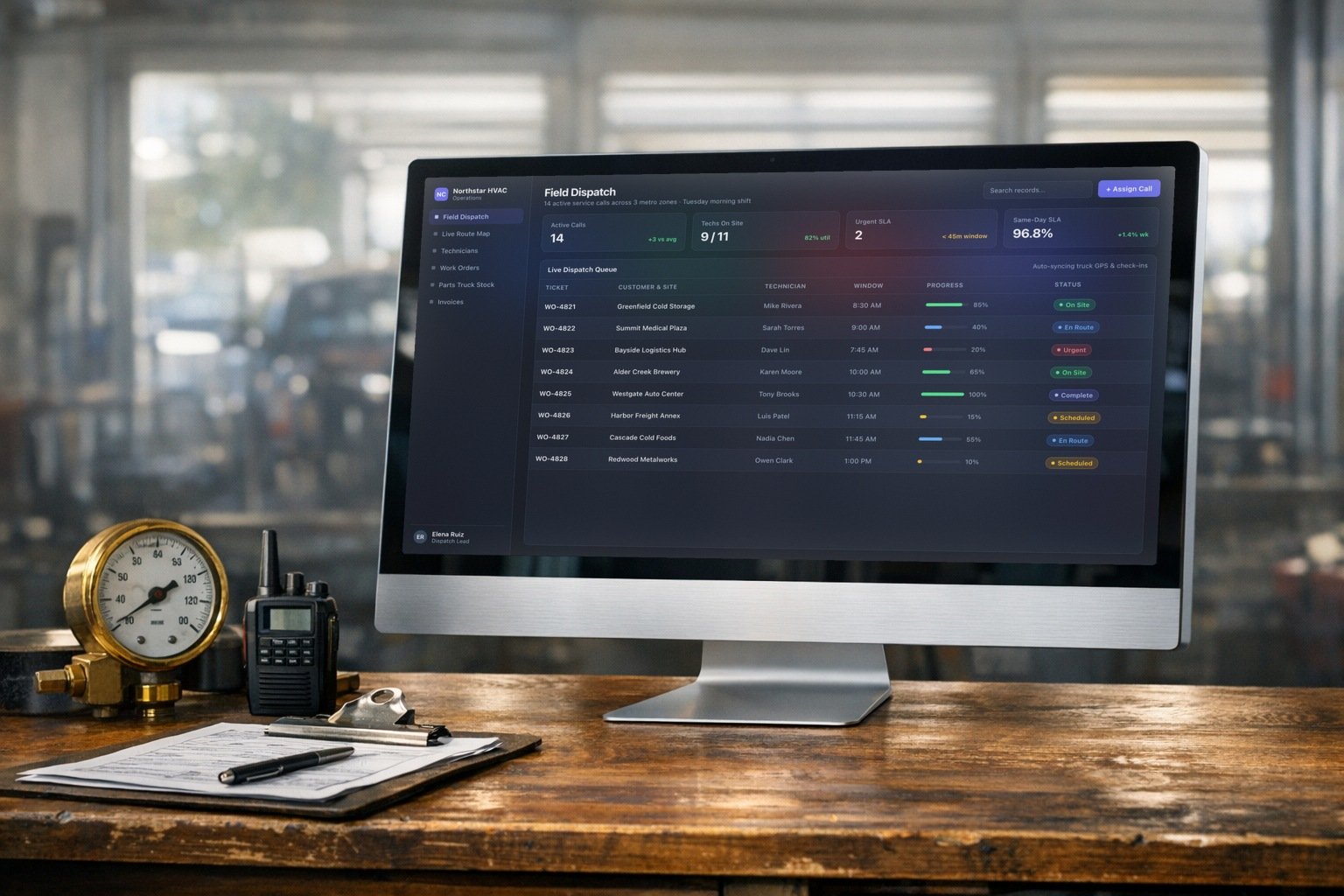
Most teams comparing Hercules and Replit are choosing between two completely different ways to build company software. One lets operations leaders ship and run custom apps without touching a code editor, while the other puts an AI coding agent inside a full cloud IDE.
Choose Hercules if you want daily business apps for dispatch, quoting, or client portals without managing terminals, deployment pipelines, or separate auth tools. Describe the workflow in plain language, and Hercules sets up and hosts the database, user logins, and backend for you.
Choose Replit if software developers are leading the build and want direct control over the codebase in the browser. It fits engineering teams that need separate development and production databases, compiled Expo mobile builds, or Bring Your Own Cloud hosting.
The comparison below draws directly from Replit's public docs and pricing alongside Hercules docs, Hercules pricing, and the Hercules Trust Center.
Quick breakdown of Hercules vs Replit
Hercules keeps code editors, environment variables, and release pipelines out of sight so operations teams can ship and adjust software in plain language. Replit puts Agent 4 on top of a browser code editor with GitHub sync, forkable dev and production databases, and Bring Your Own Cloud controls built for engineers.
| Criterion | Hercules | Replit | Edge |
|---|---|---|---|
| Build workflow | Plain-language builder, no IDE or API key setup | Agent 4, visual canvas, full browser code IDE | Hercules (non-dev teams) |
| Hosting and DB | Managed DB, higher-tier backups and region choice | Separate dev/prod DBs with 7- or 28-day rollback | Replit (dev/prod forks) |
| Auth and SSO | Hercules Auth, roles, end-user SAML/OIDC SSO, Only SSO mode | Replit Auth or Clerk; Enterprise workspace SAML/SIEM | Hercules (end-user SSO) |
| Integrations | Commerce, App Integrations, email, Agents on all tiers | Stripe, 100+ integrations, ~35 MCP servers, Ent warehouses | Hercules (all-tier stack) |
| Mobile apps | Published to Google Play and App Store (iOS beta) | Expo iOS/Android with guided App Store upload | Hercules (single-build publish) |
| Code export | Downloadable code and DB on Hercules Cloud | GitHub sync, Image Exports, BYOC | Replit (BYOC and Git) |
| Pricing | Hosting credits split from adjustable AI tiers | Starter $0, Core $20, Pro $100/mo, effort-based credits | Hercules (no effort spikes) |
Building without a code editor versus coding with Agent 4
Most operations managers don't want to debug a broken build at 7 p.m. on a Tuesday. Hercules keeps the entire build lifecycle in plain language.
You describe the screens, roles, tables, and rules your company runs on. Hercules Cloud sets up the frontend, backend functions, database, sign-in, AI Gateway, and outbound email automatically.
Nobody manages API keys or deployment pipelines, yet you still own what you build and can download the full source code and database on paid plans. Petony Transportes used Hercules to build its company ERP with no external engineering team, reporting $230k saved, 20% revenue growth, and six hires avoided.
Replit also starts in chat through Agent 4, alongside parallel task tracking on a kanban board and a visual Design Canvas. Right underneath that layer sits a full browser Project Editor meant for developers.
Engineers can inspect every file, branch with GitHub two-way sync, edit code directly, and turn on Replit's Monitoring Agent to spot and patch production errors. Non-developers can get a first version running in Replit, though diagnosing state bugs or promoting changes from dev to production goes much smoother with someone who reads code.
End-user sign-in versus workspace SAML and enterprise security
One of the sharpest practical differences shows up when employees log into the finished app. Hercules Auth ships end-user sign-in with social providers, email codes, passwords, and company SSO, plus Auth 2.0 SMS login on paid tiers.
Describe department permissions in chat and review sign-in logs under Users and Access. Connect Okta, Microsoft Entra ID, Google Workspace, OneLogin, JumpCloud, or any SAML 2.0 or OIDC provider once at the org level via Hercules SSO. Every app your team builds can use that end-user login without wiring Clerk (see Hercules pricing for SSO plan eligibility).
Restrict internal apps to "Only SSO users" mode so staff never create separate app passwords. Your identity provider enforces MFA policies and revokes access centrally across every app login, which is more secure than adding standalone per-app 2FA to separate logins.
Compared to Replit Enterprise, Hercules does not offer SIEM log streaming, automated directory provisioning (SCIM), or a builder activity log. Review current security and privacy documentation at the Hercules Trust Center.
Replit separates workspace login from app end-user login. Inside apps you build, Replit Auth shows Replit-branded sign-in screens; teams that want custom-branded login follow Replit's guided migration to Clerk Auth.
Replit's SAML SSO documentation also specifies that SAML applies to organization workspace access, not end users signing into built apps. On platform governance, Replit's security page lists published SOC 2 audit reports, GDPR documentation, and per-customer Google Cloud isolation. It also covers pre-publish SAST/SCA scanning, Trail of Bits penetration testing, Enterprise directory provisioning, and SIEM audit log streaming.
Databases, cloud deployment, mobile apps, and integrations
Hercules ships your operational stack together on every tier. Every app gets five built-in tools.
- A managed database with bulk CSV import
- Hercules Commerce for payments, products, prices, and customer records, with stock counts tracked in your app's own database tables
- Hercules Email for outbound notifications
- Hundreds of ready-made App Integrations
- Hercules Agents for recurring background work
Higher Hercules tiers add customer-enabled scheduled backups and region selection for your backend, though choosing a hosting region sets where infrastructure runs rather than creating a contractual residency promise. On mobile, Hercules ships your web app straight to Google Play and the App Store without Expo build tooling, with iOS currently in beta. Hosting stays strictly on managed Hercules Cloud infrastructure, with no BYOC or self-hosted option.
Replit gives engineering teams tighter infrastructure controls. It separates development and production databases with forkable snapshots, backing them with 7-day point-in-time rollbacks on Core and 28-day rollbacks on Pro per Replit's plan docs. When company cloud rules forbid vendor-managed hosting, Replit offers Bring Your Own Cloud on AWS, Google Cloud, and Azure plus self-hostable Image Exports.
On mobile, Replit compiles iOS and Android apps with Expo and guided App Store Connect uploads. For external services, it connects Stripe on Core and Pro and includes ~35 one-click MCP servers plus 100+ integrations. Replit Enterprise adds direct Databricks, Snowflake, BigQuery, and Microsoft Fabric links.
Predictable credit tiers versus effort-based Agent billing
Hercules splits cloud hosting credits from adjustable AI credit tiers across four plan levels. Editing bursts never cut into live app hosting, and prompt costs stay flat as your app grows.
You can start on the free tier with hosting and publishing, and use App Integrations and Hercules Agents on every plan. Paid tiers add code and database downloads plus Auth 2.0 SMS login. Higher tiers add scheduled backups and region selection.
Check current tiers and credit rates on Hercules pricing. On plans with selectable AI credit tiers, you can step down your AI tier at the end of a billing cycle while keeping your feature tier intact.
Replit meters AI work with effort-based dollar credits. Under Replit's effort-based pricing, longer chat threads and larger codebases burn more credit per prompt.
| Plan | Price | Credits and limits | Plan details |
|---|---|---|---|
| Starter | $0 | Daily Agent allowance, limited cloud | 1 published app, basic Agent |
| Core | $20/mo ($18 annual) | $20/mo credits, up to 30h Free Mode chat | Unlimited workspaces, AI integrations, 7-day DB rollback |
| Pro | $100/mo ($90 annual) | $100 tiered credits (2-mo rollover), 15 collaborators | Priority support, 28-day rollback, pooled credits |
| Enterprise | Custom | Credit commit or pay-as-you-go | Unlimited seats, SAML/OIDC SSO, dir sync, SIEM, BYOC |
Replit's tiers above come from Replit pricing and Replit plan docs. Spending past included credits bills automatically unless you put caps in place inside Replit's billing settings.
Scenarios where Replit is the stronger pick
Replit wins when software engineers will own and extend the codebase alongside AI. Developers get a browser IDE, two-way GitHub sync, branching, separated dev and production databases, and 28-day rollbacks on Pro.
It is also the better match when security policy mandates Bring Your Own Cloud or self-hosted deployments. Replit deploys via BYOC on AWS, GCP, and Azure and exports container images for companies that cannot run apps on vendor-managed clouds.
Enterprise IT governance and analytics pipelines point to Replit Enterprise as well. That tier includes published SOC 2 audit documentation, workspace SAML/OIDC SSO, directory provisioning, SIEM audit streaming, CVE/SBOM visibility, and direct hooks into Databricks, Snowflake, and BigQuery.
Finally, teams that specifically require compiled mobile binaries instead of packaged web-app store releases will prefer Replit's Expo pipeline for iOS and Android.
How do you decide between Hercules and Replit?
Choose Hercules when technical founders or operations leads want live multi-user business software without building and maintaining an auth stack. You skip the code editor, enforce end-user SAML or OIDC SSO through your identity provider without wiring Clerk, and keep hosting credits separate from AI credit tiers.
Choose Replit when software engineers own the app and want a cloud IDE with separate dev and production databases. It is also the clear choice for Bring Your Own Cloud hosting, compiled Expo mobile builds, workspace directory provisioning, or direct data-warehouse links.
Bringing a Replit project over to Hercules
Moving an existing Replit project to Hercules follows the Hercules Replit migration guide. Open the file tree in Replit, click the three-dot menu, and choose Download as zip.
Strip out node_modules, build folders, .env files, and any credentials, then re-zip the cleaned folder so it fits Hercules chat upload limits. Upload that archive inside a new Hercules project and request a migration plan so Hercules can rebuild the app while preserving your pages, components, and styling.
Database records, user profiles, API keys, and custom domains do not carry over automatically. Tell Hercules to connect the app to its built-in database and auth, import your records by CSV, and store external keys in Hercules Secrets.
Confirm sign-in and permissions with two staff roles on a Hercules subdomain before pointing your custom domain. When you're ready to import a Replit ZIP or start fresh, start building.
Frequently asked questions
Does Replit SAML SSO work for app end users?
No. Replit's SAML SSO documentation covers organization workspace sign-in rather than end users inside built apps. Teams that want custom-branded end-user login follow Replit's guided migration from Replit Auth to Clerk Auth.
By contrast, Hercules SSO brings SAML 2.0 and OIDC single sign-on directly to app end users after one organization-level setup. Turn on "Only SSO users" mode so your identity provider enforces MFA and access revocation across every app login (see Hercules pricing for plan eligibility).
Can you cap spending on Replit's effort-based pricing?
Yes. Inside Replit's billing settings, you can set usage limits and spending budgets so Agent effort charges don't run past your monthly ceiling unnoticed.
How do Replit database rollbacks differ between Core and Pro?
Per Replit's plan docs, both Core and Pro separate development and production databases with forkable snapshots. Core gives you 7-day point-in-time rollbacks, while Pro extends that window to 28 days.
Can Hercules Commerce track product inventory?
No. Hercules Commerce manages payments, products, prices, and customer records. Stock counts belong in your app's own Hercules database tables.
Can you adjust Hercules AI credits without changing your feature plan?
Yes. On Hercules plans with selectable AI credit tiers, you can lower your AI credit tier at the end of a billing cycle while keeping your underlying feature tier unchanged.